
Subscription Fragrance Programmes: Compliance Paperwork Across OEM and ODM
A combined OEM and ODM programme does not usually fail because a document is missing. It fails because nobody can say who holds it. The formula may be with the manufacturer while the safety assessment sits with the brand, the test reports may be held by a third-party laboratory, and the pack specification may exist only as an email thread. When a regulator, a retailer or a new production site asks for the file, that ambiguity is what costs time. The answer is a short custody schedule: one line per document, naming the holder, the copy the brand receives and how it is updated.
Key takeaways
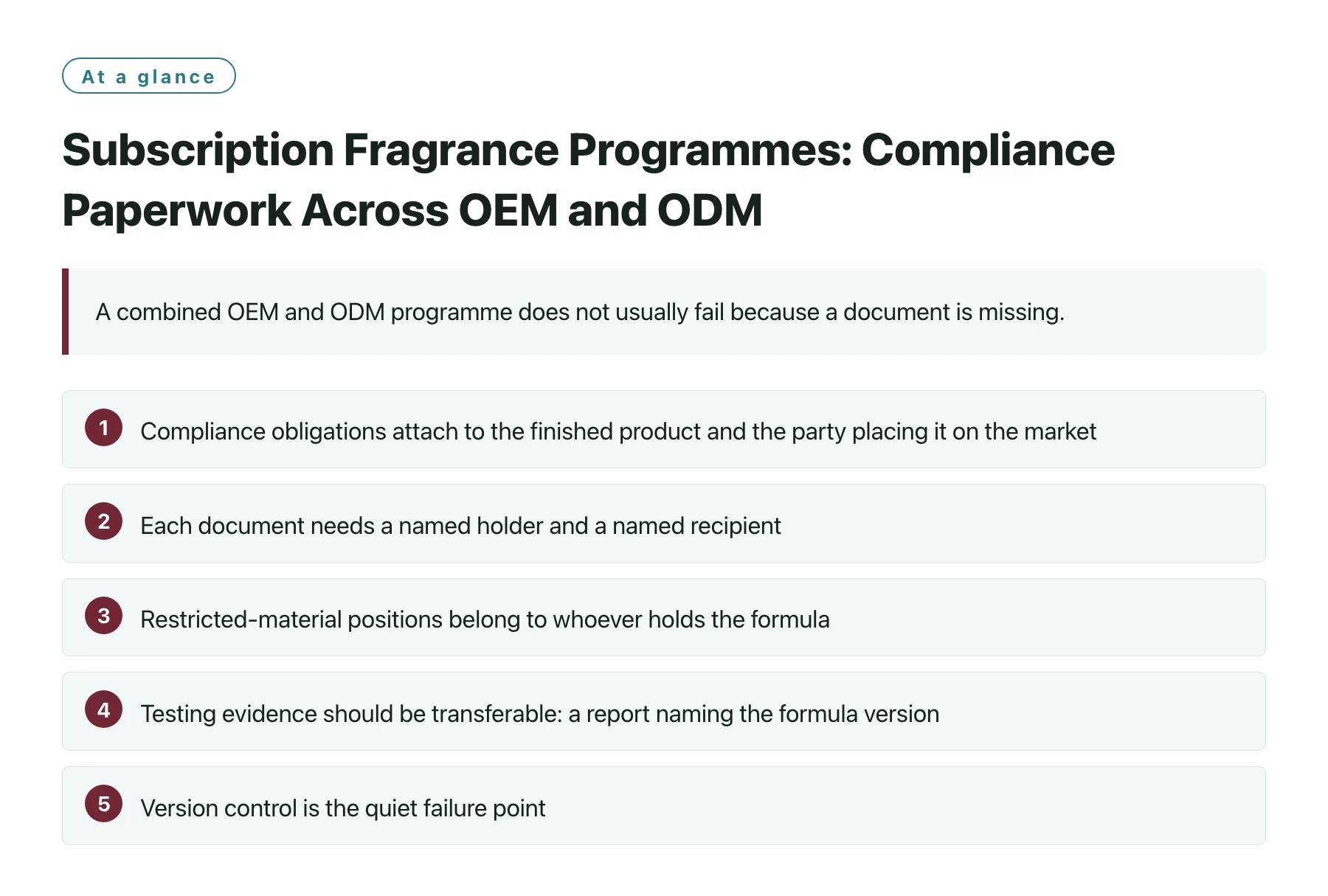
- Compliance obligations attach to the finished product and the party placing it on the market, so a factory holding the formula does not automatically hold the regulatory file [1].
- Each document needs a named holder and a named recipient, because custody that is described only in general terms tends to be interpreted in the supplier's favour.
- Restricted-material positions belong to whoever holds the formula, which means a brand running part of its range on ODM may not hold the data it needs if it later moves production [2].
- Testing evidence should be transferable: a report naming the formula version, the pack combination and the laboratory is useful to a future supplier, while a certificate with no scope is not [3].
- Version control is the quiet failure point, since a formula change without a matching update to the safety and labelling documents invalidates the whole file.
- The schedule should be reviewed at every formula change, every pack change and every new market, which is three moments rather than a continuous process.
A subscription fragrance line tends to grow into a mixed programme. The hero scent is developed with the brand in control, while flankers and adjacent formats are bought from compositions the manufacturer already holds. Both arrangements are legitimate, and they produce two different document trails inside one company.
The difficulty is not regulatory in the abstract; it is administrative. Documents arrive in different formats, from different parties, at different points in the year, and each one assumes a slightly different definition of who is responsible. Six months later, when a retailer asks for the compliance file, assembling it becomes a project.
A custody schedule is the cheapest fix available. It is one page, it is written during the commercial negotiation rather than afterwards, and it converts an open question into an assignment.
The custody question decides everything else
Before listing documents, settle one principle: the compliance file follows the product, and the product is placed on the market by a specific party. In most markets that party is the brand or an entity acting for it, even when the formula, the development work and the manufacturing all sit with a factory [1]. Every other arrangement is a way of supplying that party with what it needs, and the principle holds just as firmly in contract perfume manufacturing in China work where the brand may never meet the formulator.
Once the principle is fixed, the questions become practical. Who holds the original, who holds a copy, who is obliged to update it, and how quickly is an update delivered when a formula or a pack changes?
Why a mixed programme needs this more than a single-model one
In a pure brand-led arrangement, one company tends to accumulate the whole file because the same team commissions the development, the testing and the packaging. In a mixed programme, two supply relationships exist in parallel, and the surrounding documents are produced by different parties under different commercial terms.
That is not a reason to avoid the model. It is a reason to describe it explicitly, which is also what what to verify before signing with a fragrance manufacturer should cover, since a supplier that expects to hold part of the file will usually say so plainly when asked.
Two clauses that prevent most of the trouble
The first clause names the holder of each document and the form in which the brand receives a copy. The second requires notification when anything changes, including a formula adjustment, a supplier substitution, a packing change or a shift in the restricted-material position [2].
Both clauses are easy to agree at the start and difficult to negotiate once a product is selling, because by then any change is disruptive and each side has an interest in the status quo.
Reviewing the schedule after a change
The schedule only earns its keep if it is revisited. A formula adjustment, a component substitution or a new market all change what the file has to contain, and each of those events is a natural moment to confirm that the named holders still hold the current version. Writing that review into the agreement as a trigger rather than as a calendar item keeps it from being forgotten in a busy quarter.
Documents to place on the custody schedule
- The formula record, with the version that is currently in production and the dosage at which it is used.
- The restricted-material review for the product category the finished item is sold in, including the date it was last checked.
- Safety assessment or equivalent documentation for the finished product, naming the party that commissioned it.
- Compatibility and stability results for each formula and pack combination, with the laboratory identified and the conditions stated [3].
- The packaging specification, including component materials, decoration and fill weight, at the version that was actually produced.
- Labelling inputs derived from the formula, such as the ingredient declaration and any allergen information required in the destination market.
- Batch records or certificates of analysis for shipped lots, in the redacted form the supplier is willing to release.
A useful test of any proposed file structure: pick one shipped batch at random and ask both sides to produce, within a day, the documents that relate to it. If the exercise takes a week and involves three companies, the schedule needs writing. A programme run with a Xuelei fragrance OEM and ODM manufacturer can still hold a clean custody line, but only if the split is stated rather than assumed.
Sources
- European Commission: Cosmetic Products — Specific Topics —— EU pages covering specific cosmetics topics such as product claims, nanomaterials and animal-testing rules.
- IFRA Standards Library (International Fragrance Association) —— The IFRA Standards Library lists the restrictions the fragrance industry applies to individual fragrance ingredients, based on safety assessments; it is the reference point for compliant fragrance formulation.
- SGS: Cosmetics, Personal Care & Household Testing —— Testing, inspection and certification services for cosmetics and personal care, including microbiological, stability and safety testing aligned with cosmetics GMP.
Frequently asked questions
Who is responsible for compliance when a factory develops the fragrance?
The party placing the finished product on the market is normally responsible, which for most brands means the brand or an entity acting on its behalf, even when the factory developed the formula. The factory supplies the technical data; the brand holds the obligation.
What is a custody schedule and why does it help?
It is a short table listing each document, who holds the original, who receives a copy and how updates are notified. It helps because ambiguity about custody is the most common reason a compliance file takes days to assemble when it should take hours.
Can a brand move production to a new factory if part of the range was ODM?
It depends on the rights attached to the composition and on what the brand holds. A formula record, a current restricted-material position, test results naming the version tested and the labelling inputs make a move practical; a relationship based on the factory holding everything makes it difficult.
How often should the document file be reviewed?
At three moments: when the formula changes, when the pack changes, and when a new market is added. Continuous review is unnecessary, but a change that is not reflected in the safety and labelling documents invalidates the parts of the file that depend on it.
Does OEM or ODM produce more paperwork?
Neither model is inherently heavier. What differs is who produces which document. A brand-led arrangement concentrates the file with the brand, while a development-led arrangement spreads it between the brand and the manufacturer, which is exactly the situation a custody schedule is designed for.
Map your quantum-vulnerable surface.
A 30-minute cryptographic risk assessment with a Q6of solutions engineer.